2. Breifly describe why each of these 3 construction methods are energy efficient?
Monday, September 29, 2008
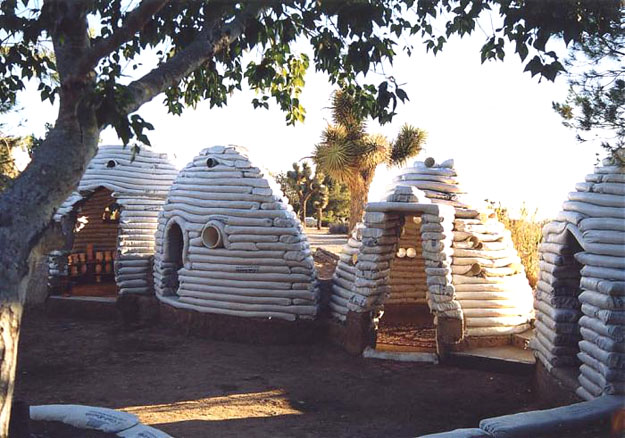
Go Green with Sandbag Homes
2. Breifly describe why each of these 3 construction methods are energy efficient?
Monday, September 22, 2008
Saving Our Oceans
Discovery Questions:
1. Name and describe the physical and biolocial components of another reef ecosystem around the world? For one point extra, turn in an ecosystem map of a coral reef habitat.
2. What human activites do scientists contribute to the decline of coral reefs?
3. Why are sharks considered keystone species of many reefs, according to the article?
4. How do environmental scientists monitor the health of coral reefs?
5. What are the economic complexities around the establishment of a marine reserve, as explained in the article and your research?
6. What is the role of the Endangered Species Act and conservation organisations in preserving our oceans?
Resources:
Our Imperiled Oceans -
http://www.smithsonianmag.com/science-nature/victory-at-sea.html
Ecosystem Assessment Division of NOAA - http://www.nmfs.noaa.gov/habitat/ead/EADhome.htm
Reefs at Risk, World Resource Institute -
http://www.wri.org/project/coral-reefs
Conservation International -
http://www.conservation.org/Pages/default.aspx
Endangered Species Act -
http://www.nmfs.noaa.gov/pr/laws/esa/
Thursday, March 13, 2008
Super Eruptions and Climate

Over the winter break I had the opportunity to go on a geology tour and visit a volcano. One of the features I witnessed, was the intrusion of dikes into the monzogranite formation of the area. Coming back to school and starting the geology unit for AP Environmental Science got me thinking about the importance of volcanoes and how they effect the environment. While they can be destructive, are there any benefits to the environment? The blog this week asks students to explore short-term and long-term benefits to the environment of volcanic eruptions.
Questions:
1. What are the characteristics of a volcanic explosion?
2. What are some of the most destructive volcanic explosions in the history of the planet?
3. What is the relationship between volcanoes and climate change throughout history?
4. What are some of the short-term and long-term benefits of a volcanic explosion to the environment? Look at climate, soil, biodiversity, and human agriculture.
5. How did the Toba super eruption effect the evolutionary history of humans?
Resource:
Mystery of the Megavolcano - http://www.pbs.org/wgbh/nova/megavolcano/about.html
* Pay particular attention to the links at the bottom right of this page.
The Genographic Project - http://www.pbs.org/wgbh/nova/megavolcano/about.html
* Pay particular attention to human migrations during the time period of the Toba eruption.
USGS Volcano Hazards Monitoring Program - http://volcanoes.usgs.gov/
* Pay particular attention to the Volcano Monitoring link.
Tuesday, February 19, 2008
Wolves in Yellowstone

Was flying to Chicago this weekend and read on the plane about this conservation group in Minnesota that was monitoring and preserving wolves. It was a good piece of luck, considering I had just showed the National Geographic movie Wolves: A Legend Returns to Yellowstone. The movie discusses the reintegration of a wolf pack into Yellowstone park and also discusses conservation management techniques and radio telemetry used to monitor the wolves. Searching blogs and discussion groups on the internet shows that it is still a topic of heated debate between local ranchers, environmentalists, park officials, and eco-tourism businesses.
1. Discuss one pro and one con of reintroducing wolves into Yellowstone from one of the following perspectives (rancher, environmentalists, park ranger, eco-tourism owner).
2. Discuss the steps environmentalists take to ensure the successful reintroduction of wolves.
3. Explain how radio telementry can be used to monitor wolves.
4. Discuss what data can be obtained from such a monitoring system.
5. What dangers to the wolves face (human, climate, predators, other wolves)?
Resources:
Track Wild Wolves - http://www.wolf.org/wolves/experience/telemsearch/vtelem/telem_intro.asp
Wolves of Yellowstone - http://www.yellowstonenationalpark.com/wolves
Yellowstone Bearman - http://www.yellowstone-bearman.com/wolves.html
Wolf Ecotourism Fact Sheet - http://www.biodiversitypartners.org/econ/report/ecotourism_fs.shtml
Wednesday, January 23, 2008
Overfishing
A recent NPR.org podcast reports an increase in overfishing, mainly due to the U.S. and Europe's desire to eat more fish. This got me wondering how many other countries are jumping on the "eating fish is healthier" bandwagon and contributing to the rapid decline of global fisheries. A quick search of Google News found an article summarizing a series of studies that local taboos in most developing countries have stymied overfishing of local reefs. In this light, then...
Questions:
1. List one developed country and one developing country that are to some extent contributing to the decline of global fisheries. Describe the difference between these two countries in terms of their GDP. What is their import/export of global fish stocks?
2. Describe one cultural practice in a developed country that is contributing to the decline of global fisheries and one cultural practice in a developing country that is helping to prevent the decline of global fisheries.
3. Describe two types of technology that are being used in commercial fishing and for each type of technology describe one environmental problem that arises from its use.
4. What is one legislative law that regulates global fisheries, and explain under what circumstances this law is suspended and/or reinstated.
Resources:
A Dire Prediction for the Future of Sea Life - http://www.npr.org/templates/story/story.php?storyId=6469061
Local Taboos Stop Overfishing -
http://www.sciencealert.com.au/news/20082301-16816.html
Until the Fish are All Gone -
http://www.nytimes.com/2008/01/21/opinion/21mon1.html?_r=1&hp&oref=slogin
Scientists Use Satellites to Track Fish - http://www.sfgate.com/cgi-bin/article.cgi?file=/chronicle/archive/1998/08/05/MN82865.DTL
Fishery Conservation and Management Act - http://www.nmfs.noaa.gov/sfa/magact/mag1.html
Overfishing Presentation - http://goapes.wikispaces.com/overfishingpresentation
Thursday, December 6, 2007
Greening of Golf
Questions
1. Use the Internet to research the location of 3 golf courses, then geomark them on Google Maps.
2. Describe 2 common practices by golf course superintendents that could lead to soil or groundwater contamination.
3. For the practices mentioned in #2, describe 2 soil and/or water tests that should be taken regularly by golf courses to prevent soil or groundwater contamination.
4. Describe 2 health effects from groundwater contamination of excess nitrates.
5. Describe 1 negative effect golf courses have on the environment and provide 1 example of a golf course that is altering its practices in order to mitigate the negative effects of golf courses on the environment.
Resources
Greening Golf Video
http://www.youtube.com/watch?v=sfUuBTu9PeA&eurl=http://goapes.blogspot.com/
The Greening of Golf
http://www.delta-sky.com/2007_11/greenscene/
Greening Up Golf Courses
http://www.jsonline.com/story/index.aspx?id=183864
Greening of the Golf Course Greens
http://www.jgpress.com/inbusiness/archives/_free/001106.html
Audubon Cooperative Sanctuary Program for Golf Courses (ACSP)
http://acspgolf.auduboninternational.org/
Green Golf Course KMZ Layer on Google Page Creator
http://tcooper66.googlepages.com/goapesingooglepagecreator
Tuesday, November 20, 2007
Let's Switch to Biofuels

2. Describe 2 advantages and 2 disadvantages of using biofuels.
3. Describe the process of extracting energy from the Earth's biomass.
4. Discuss how they are using genetic engineering and directed evolution to improve the process and make it economically viable.
5. What changes would we need to make to our agricultural and industrial infrastructures in order to deploy biofuels?
http://www.ted.com/index.php/talks/view/id/193
One Molecule Could Cure Our Addiction from Oil - Wired
http://www.wired.com/science/planetearth/magazine/15-10/ff_plant?currentPage=all
Alternative Energy News - Biofules
http://www.alternative-energy-news.info/technology/biofuels/
The False Hope of Biofuels
http://www.washingtonpost.com/wp-dyn/content/article/2006/06/30/AR2006063001480.html
Friday, November 9, 2007
Oil Spill in San Fran Bay

Questions:
Bay Oil Spill -
http://www.loe.org/series/exxon/exxon.htm
Wednesday, October 31, 2007
Wildfires

1. Name two biological communities that experience wildfires.
2. Describe the beneficial role of fire to an ecological community?
3. Define the term succession and describe what role it plays in the evolution of an ecological community. Is fire an example of primary or secondary succession? Support your reasoning.
4. For one of the communities chosen above describe the 4 stages of ecological succession. Discuss the role (facilitation, inhibition, tolerance) of either a plant or an animal for each stage of succession.
5. Describe one fire management technique and one fire suppression technique used today by the US Forestry Service.
Resources:
California Wildfires on Youtube - http://www.youtube.com/watch?v=Kr80oRpD6vI
U.S. Fish and Wildlife Service Fire Management - http://www.fws.gov/fire/living_with_fire/
Ecological Succession on Wikipedia - http://en.wikipedia.org/wiki/Ecological_succession
USGS Wildfires Fact Sheet - http://pubs.usgs.gov/fs/2006/3015/2006-3015.pdf
Technology Review's Mapping Wildfires - http://www.technologyreview.com/Infotech/19324/
Wednesday, October 17, 2007
Planet in Peril
1. Participate in the Roundtable Discussion. Send in a picture (or preferably a video) of your question to CNN at the link below and it may be included on the show.
2. Watch the show on Oct. 23rd and 24th and each night post your response to our blog.
3. Create a podcast on "How Green Your Are" and submit it to CNN. They may use it in a news broadcast.
Any change in our planet will come from each individual trying to make a difference. This is your opportunity to use Web 2.0 technologies to educate others, get your opinions out there, and show how you are helping to improve our world.
Resources:
Planet in Peril - http://www.cnn.com/SPECIALS/2007/planet.in.peril/
Wednesday, September 26, 2007
Are Hurricanes Increasing?

1. What conditions are necessary to produce a hurricane?
2. What governmental organization monitors severe weather?
3. Have the intensity or frequency of hurricanes changed over the past 50 years? Graph the data at the resource below and explain the results.
4. What are some of the effects of hurricanes to our society?
5. What can you do to be prepared for a disaster?
Resources:
1. Hurricanes - National Oceanographic and Atmospheric Association
http://hurricanes.noaa.gov/
2. Past Hurricane Data from the National Hurricane Center
http://www.nhc.noaa.gov/pastdec.shtml
3. Katrina Hurricane Video - YouTube
http://www.youtube.com/watch?v=pvoEiBnpCc8
Tuesday, September 18, 2007
The Amazing Albatros

Yesterday, I was waiting the orthodontics office looking for something to read and came across an article on the albatross in the latest edition of the Smithsonian magazine. I was amazed when I read that the albatross can fly 50 miles per hour and go years without touching land. As I read on, I learned that they mate for life, and they can somehow even predict the weather. And yet, even with all of these amazing abilities, they are among the world's most endangered birds. I found this somewhat unbelievable due to their similarity in life span and reproduction habits to humans. From my antidotal observations, humans tend to spend more time and money preserving species that we have something in common with, rather than their significance in preserving an established ecosystem. So, I thought what a great opportunity to learn about the albatros' habitat, their role in the environment (or niche) and some of their unique requirements. Take a look at the resources below and then answer the following questions:
1. Briefly describe the albatross' habitat an niche. You should talk about the physical characteristics of the bird species, its population size, its geographic range, its feeding requirements, and its nesting and reproduction requirements. All of these are important in understanding why the bird is threatened.
2. What technology is being used by scientists to learn more about the albatross' habitat and niche? Give a basic description of GPS technology and also some of the problems the scientists are having with the technology.
3. Discuss one natural and one man-made disaster that are making it difficult for the albatross to increase its population size.
4. Discuss two cases of how technology (other than GPS) is being used to preserve the albatross.
Resources:
The Amazing Albatross
http://www.smithsonianmagazine.com/issues/2007/septembe
Tuesday, September 4, 2007
Artic Resources Up for Grabs
Over the past couple of months there have been a number of news stories on the 5 countries that have arctic coastlines and are trying to stake a claim to possible resources in the arctic. If nations were allowed to extract these resources, there could be drastic changes in the arctic ecosystem.
1. What resources are nations expected to find in the arctic?
2. Are these resources considered renewable, perpetual, or nonrenewable?
3. How could large scale extraction of these resources cause a shift in climate conditions?
4. What organisms live in the arctic and how would changes in climate affect their survival?
Resources:
Nations Jostle for a Share of the Arctic
http://www.npr.org/templates/story/story.php?storyId=14092469
Global Warmng Polar Bears
http://www.youtube.com/watch?v=UQivFU_H5pk
Arctic National Wildlife Refuge
http://arctic.fws.gov/
Monday, August 27, 2007
Manufactured Landscapes
1. What type of human activity (e.g. mining, logging, etc.) caused the change in landscape?
2. What products are made from the use of this resource?
3. Research one example for the pollution caused by 1) extraction of the resource; 2) production; 3) distribution of the resource.
References:
1. Art of Edward Burtynsky
http://www.edwardburtynsky.com/
2. Manufactured Landscapes Official Site
http://www.zeitgeistfilms.com/film.php?directoryname=manufacturedlandscapes
Friday, August 17, 2007
Easter Island's End
1. Discuss two environmental factors that lead to population increases on the island?
2. Discuss two cultural practices that eventually lead to the collapse of the ecosystem on Easter Island?
3. Define sustainable development and discuss what changes in cultural practices would have been necessary in order to prevent the collapse?
4. What archaeological evidence has been found to support this theory of population increase, environmental degradation and collapse?
5. Make one comparison between this ecosystem and society and our society today.
References:
Easters End, Discover August 1995
http://discovermagazine.com/1995/aug/eastersend543/?searchterm=Easter's%20End
NOVA: Easter Island
http://www.pbs.org/wgbh/nova/easter/
Film: Easter Island in Context: From Paradise to Calamity
http://www.films.com/id/4697/Easter_Island_in_Context_From_Paradise_to_Calimity.htm
Monday, August 13, 2007
Challenges We Face
In September 2002, an environmental article in Time Magazine reviewed a number of environmental challenges our planet faces. Even though this article is becoming dated, I think it is a great starting point for students wanting to study environmental science. I encourage each of you to read the article and familiarize yourselves with the issues discussed. For this assignment, write a response about the article:
1. Why does the article imply that humans cannot destroy the Earth? Do you agree or disagree and why?
2. What are the major categories of hazards discussed in the article?
3. Choose one of these areas and give 3 suggestions on how we might solve or at least elevate the severity of the problem.
4. How could you change your lifestyle to help alleviate the problem?
Resources:
Challenges We Face, Time 2002 http://www.time.com/time/magazine/article/0,9171,1003114,0
Thursday, March 1, 2007
FRQ #7 - Superfund and Brownfields
a. Is there a difference between a brownfield and superfund site?
b. Describe three sites in your local area that are either a brownfield or a superfund site and then briefly explain how the land became contaminated? You can create a map at the EPA site for you area.
c. Choose one of the types of contamination listed above and describe two environmental impacts that could arise.
d. What is bioremediation and explain two recent advances and how they are being used to clean up contaminated sites.
Resources:
Toxic Pollution in Your Back Yard
http://www.npr.org/templates/story/story.php?storyId=6230678
Brownfield Cleanup and Restoration at http://www.epa.gov/swerosps/bf/
Superfunds at http://www.epa.gov/superfund
Bioremediation from Wikipedia at http://en.wikipedia.org/wiki/Bioremediation
Friday, February 23, 2007
FRQ #6 - Mapping Our Planet
a. Define remote sensing.
b. Describe two ways imaging and remote sensing technology have helped environmental scientists to see our changing world.
c. Describe two different types of sensors that have been mounted on a satellite.
d. Choose one of the sensors that you mentioned above and list one advantage and one disadvantage of mounting it on a satellite rather than using it on the ground.
e. Describe two ways that satellite data has changed our everyday lives.
Resources
1. Amazing Grace at http://science.nasa.gove/headlines/y2001/ast300oct _1.htm
2. Information on how NASA is using satellites to study the environment at http://www.nasa.gov/vision/earth/technologies/index.html
3. Gravity Recovery and Climate Experiment at http://www.csr.utexas.edu/grace/mission/project.html
4. Remote Sensing Basics at http://en.wikipedia.org/wiki/Remote_sensing
Thursday, February 15, 2007
FRQ #5 - Frog Fungus
a. What biological characteristics of frogs make them susceptible to minor changes in their environment?
b. How can frogs be used as indicators of environmental problems?
c. What is the role of zoos in helping to conserve threatened or endangered species?
d. What legislation could prevent the spread of this fungus?
Resources
Fungus Identified in Frog Population Decline, NPR January 12th, 2006 -http://www.npr.org/templates/story/story.php?storyId=5151096
Frog Disease Chytrid Fungus - http://ap.lancasteronline.com/4/japan_frog_fungus
Amphibian Conservation Alliance - http://www.frogs.org/
AMNH: Frogs, A Chorus of Colors - http://www.amnh.org/exhibitions/frogs/
Thursday, February 1, 2007
FRQ #3 - Amazon Forest to Farms
a. Briefly describe abiotic requirements (e.g. water, temperature and soil) of a tropical rain forest.
b. What effect will large-scale monoculturing of soybeans have on the land? Make sure to include a short description of the nutrient requirements of soybeans before touching on the long-term effects of monoculturing.
c. List 2 important plant species that are threatened or endangered by deforestation in the Amazon and describe their potential uses to our society.
d. Discuss one advantage and one disadvantage of using remote sensing techniques to monitor illegal timber activities.
e. Voice your opinions on the question above.
Resources:
1. Amazon Forest to Farms in National Geographic Magazine (January 2007) at http://www7.nationalgeographic.com/ngm/0701/feature1/index.html
2. Amazon Scenarios from the Woods Hole Research Center
http://www.whrc.org/southamerica/amaz_scen.htm
3. Remote Sensing Basics at http://en.wikipedia.org/wiki/Remote_sensing
Just for Fun:
You can download Google Earth and take a look at "The Soybean Highway"(BR-163). After Google Earth loads, point the Earth at Brazil and add the layer map for roads. You can then zoom in and see the amount of deforestation happening along this road.